
The Mechanic St Landfill: What You Should Know
Apr 16, 2025
Filed under: Environmental Impact Public Safety
Most people are aware that the Fairgrounds is proposing to build their racetrack on top of the closed Mechanic Street Municipal Landfill.
This fact has caused quite a stir in Leominster, where many residents vividly remember visiting the landfill while it was still in use. Baystate Racing has airily promised that they will not harm or compromise the landfill in any way, and (boldly) even implied that they will do a better job managing the landfill than the City. Their plans, however, seem to say otherwise. How unsafe is it, really? Let’s get into it.
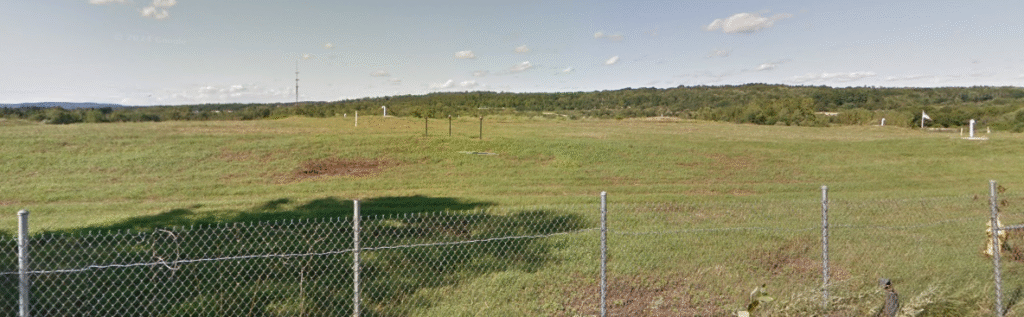
Since its conception as a swamp burn pit in approximately 1890, over 2 million cubic yards of solid waste were deposited into the landfill until it closed in the late 1980s. It comprises the entire “hill”, from the Leominster Connector to Mechanic Street. Today the top is level with the road, but historic maps show there used to be a steep slope from Mechanic Street down to a large wetland area. The entire landfill is located on top of this wetland, which was most likely a wooded swamp or marsh.
The elevation of the original wetland was probably about 300 feet above sea level, while the elevation of the current mound is about 340’. It is completely fair to say that the landfill is 30 acres and 40 vertical feet of municipal garbage, burn debris, and industrial and chemical waste. There is no part of the landfill’s “hill” that contains bedrock, stone outcrops, or anything else that you would assume a hill is made of. There are probably millions of trash bags. The thousands of 55-gallon chemical drums have deteriorated until they are like eggshells. In many areas of the bottom, the solid waste is underwater. This is why the landfill is still making methane: methane is produced from water+decomposing carbon materials, and the bottom is always wet.
Leominster, famously a center of plastics manufacturing, once boasted over 60 plastic and chemical manufacturers. Industry dumping at the site took place from the mid-50s to the late ’70s, and the vast majority was unregulated or done at night. Only one company alerted the EPA to their dumping, Borden Chemical, and that one admission caused the landfill to be entered into the Superfund program for assessment. It’s impossible to truly know the full scale of the chemicals and toxics poured into the area–but Leominster was a top plastics manufacturer in the US for decades, and there was only one landfill.
Known industrial wastes disposed of at the site include polyvinyl chloride and the human carcinogens trichloroethylene and vinyl chloride. Vinyl chloride is a mutagenic group 1 carcinogen associated with rare angiosarcomas, brain tumors, lung tumors, and malignant lymphatic tumors. It also causes miscarriages, birth defects, and a host of other serious conditions. Testing throughout the years has identified huge amounts of landfill gas, copper, arsenic, and other chemicals that cause endocrine disruption, reproductive harm, and developmental disorders. Pentachlorophenol, a probable human carcinogen that damages the liver, kidneys, blood, and nervous system, was identified in the groundwater in the 1980s. Benzene, a known human carcinogen, is regularly found in groundwater tests, including a recent exceedence. Runoff from the site and area groundwater flows northeast and directly into the Nashua River.
Normally, a landfill that contained municipal and industrial waste would be classified as a “subtitle C” landfill, which specifically contain hazardous materials that may pose a significant threat to human health or the environment. Subtitle C landfill are very carefully designed in a “cup” shape, with specific liners on the bottom and sides to prevent the contents from contaminating the surrounding environment. They have their own leachate systems and are carefully monitored.This landfill, which has no classification due to its status as a “grandfathered” site, was not designed at all (there is no liner whatsoever) nor is it contained in any meaningful way. Indeed, the only way the City of Leominster could have created a more unstable landfill was if they were also allowing the dumping of nuclear waste or mining slag. The fact that there has not yet been a serious crisis stemming from landfill contents isn’t due to good management, but rather a matter of almost incomprehensible luck.
The landfill was capped in 1997, and because the cap cannot be breached and is only a few feet below the surface, Baystate cannot do any digging or excavations. The integrity of the cap must be maintained to prevent water from entering the landfill and creating methane and leachate (concentrated chemical waste). There are numerous landfill gas vents, encased in concrete, scattered throughout the site–the bases of which are installed underneath the cap. It is unclear if, at this moment, Baystate is aware that the gas vents are partially under the cap–they have promised to “move” the vents, but that may be harder than they anticipate. Furthermore, most of the important testing wells are on the outside edge of the landfill to ensure that landfill gas, which is highly combustible, does not escape into neighborhoods (again). On the Fairgrounds’ site plan, the entire outside edge is taken up by….a racetrack. In some areas, a racetrack that’s on top of a retaining wall. This, too, will have to be “figured out”.
With that being said, the fact that they can’t dig presents a major problem. The area is intentionally graded to a certain slope (for drainage), and there are some “peaks” above particularly large buried items. How, then, to flatten the area? According to their Host Community Agreement, Baystate plans to raise the elevation of the entire landfill to approximately 360 feet. This eliminates the need for digging and ensures the track and interior area will be completely flat and level. While this will obviously have a major impact on the site’s drainage, far more damaging will be the compression forces from the enormous weight of the materials required to level the entire 30 acres. To reach that elevation, the surface will have to be raised between 5 and 30 feet, depending on the area. As a thought experiment:
- Assuming an average elevation increase of 20 feet on an area approximately 1400 ft by 900 ft,
- it gives us a whopping 25 million cubic feet of added material.
- If we assume 1 cubic foot of soil weighs 100 lbs,
- this portion of their project could add 1 million tons (or more!) of weight.
This is not including retaining wall materials, stones for the track underlay, construction equipment, or vehicles. All of this weight will sit directly on top of a 30 year old plastic cap and a hill made entirely of garbage that sits in water. Whatever structural stability the landfill mound might have, it certainly will not be able to maintain it under such weight for a prolonged period of time. It isn’t if it starts collapsing, it’s when. Have you ever wrung out a really nasty kitchen sponge? Imagine that, but the sponge is a quarter mile long and full of human carcinogens.
If this project moves forward, nobody will be worrying about what half of what percent Baystate is paying the City, where tourists are going to park, or whether or not residents have a different place for the farmer’s market. We’re going to be worrying about contaminated water, downstream communities, and how the City of Leominster is going to come up with the tens of millions of dollars they will need for litigation fees and settlements. This possible future, engineered by Baystate Racing, would only result in a catastrophic environmental and public health crisis.
But it won’t, if we stop it.